Monday, November 29, 2010

Starry Night By:Vincent Van Gogh


Vincent Van Gogh could be considered one of the worlds most famous painters. His impressionism style is one in his own. A Starry Night is seen all over the world. I remember having to recreate it in 5Th grade art class.


Van Gogh grew up in a very religious family. His Father was an Evangelical Pastor. Van Goghs life centered around these three things: Contemporary lit., Philosophy, and history. Van Gogh didn't begin painting until 1880 after deciding he wasn't meant to follow in his fathers footsteps and be a minister.


Starry night is a very beautiful picture of a town on a clear night. The Gusts of wind blowing through the town and the lights out make the town look like a quiet town fast asleep on a cold winter night. There are 12 stars in the sky symbolizing the end of something and the beginning of new journey. Just like when the clock strikes 12 it's the end of one day and the start of another. He showed this to help him in trying to forget a past lover and her daughter that he had a problem with. The mountains in the back symbolize guidance for his journey. The church in the town with the large steeple stands out because of his large religious background. The tree is a representation of God watching over the town and keeping them safe. It isn't blowing in the wind so it is a figment of Van Goghs imagination and his image of God. It is much larger than everything else because He is power full and almighty. It is painted black because I think at the time Van Gogh may be questioning his beliefs is a sense that there as still a God but maybe he isn't who he thought he is. Because of Van Goghs past with his ex-lover and Daughter he is Questioning why God would put him through such pain. This painting was created by Van Gogh to help him get over his past and begin a new journey in life

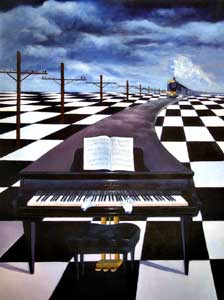
"Road to Nowhere"

This painting called "Road to Nowhere" was done by a Russian surrealist painter named Leonid Shchigel. He's an up an coming artist who takes after Salvador Dali's surreal paintings. Shchigel had no art degree and was completely self-taught as an artist. It wasn't until he began his job as a security guard that he practiced his art daily-utilizing all the free time he had working in the grave yard shift. Rather than focusing on the realistic qualities of life he noticed the unrealistic, but beautiful, qualities dreams so greatly exhibit.


In this painting there is a black piano that turns into train tracks, going into the distance. There is a train in the distance that is coming toward the foreground. It is kind of clear sky's in the distance but closer to the piano there is dark and gloomy sky's. The floor is black and white checkered, like the colors of the keys on the piano. There is a music book on top of the piano opened face up. There is electricity lines down the length on the tracks. There is smoke coming from the train. There is a chair under the piano and the piano looks brand new and not used. No one is to be seen in this painting, the only person maybe would be the train conductor. There are white gloves on the piano "playing" but no visible person.


Our interpretation of this painting is that the train that is in the distance coming towards the foreground is taking a journey to a "darker world". With the clear sky's in the background and the dark, black sky's in the foreground this represents the coming to the "darker world". The dark sky could represent worries and challenges that are going to have to be faced sometime in the near future. Another thing is there are more geometric shapes on the ground and are more defined than all of the other shapes in this painting.

The Island by: Steve Chmilar

The painting the Island was done by a musiscian/artist named Steve Chmilar. He was born in Grande Prairie, Alberta (Canada) on Decemeber 25, 1979. He began painting at age 2 but put that dream on hold to pursue his interest in music. Then in 2007, he moved to Vernon, B.C. to focus on his painting. Chmilar does neosurrealism or modern surerealism, which illistrates the complex imagery of dreams or subconscius visions in irrational of dreams or subconscious visions in irrational space and froms combinations (wikipedia). In the painting there is an island with a huge tree in the center. On one side is a fat, white man with all kinds of food and wine and he is looking in a mirror just staring at himself. On his side of the tree leaves are growing showing his life is fullfilled and lively. On the other side of the tree has no leaves and there is a Native American family with nothing, they are naked and skinny.
The tree reprsents life and knowledge, on the one side with the white male the tree is alive and on the side with the family it is dead. We believe that the man with all of the belongings represents wealthy cultures, especially white people and how they only care about themselves and their possesions. But just on the other side of the earth there are starving families with nothing like the Native Americans in this painting. They may be as close as on the other side of a tree and the wealthy people are too busy worrying about themselves to even notice.

Stuggle In The South


Joe Jones was Born on April 7th, 1909. He grew up in St. Louis Missouri and went to school there. At age 15 he quit school and started painting houses. At 27 he moved to New York City and lived there for the remainder of his life. His first appearance was a a painting called "Wheat". Some of his early paintings were very Midwest regionalistic. Later in life Jones became interested in delicate lines, and low toned colors. Some of his other famous works include "American Justice" and "House Painter". Joe Jones Died on April 12th, 1963 at the Age 54 years old.


This painting shows the definition of lynching. Two white men are getting ready to hang an African American from a tree. One of the men has his fingers dug into the African Americans eye and skull. The African Americans wife and son are standing to the right and she is shaking her fist at the men. There is a house on fire in the background that assumingly belongs to the black family. It's after the civil war because the black family have their own land. They are sharecroppers who grow cotton which is visible in the middle of the painting. It shows the violence that continued to happen to blacks even though they were free. One of the white men's faces is completely distorted. The female looks extraordinarily strong.
-Archetypes-
Tree- Represents life, but in this painting it represents death because the African American is getting hung from it.
Fire- Represents pain because that's all that a fire brings.
Innocent-child/youth- The child in this looks scared and does not understand what is going on. Meaning that not all things are meant to be understood in life.
Villains/Evil Figure- (The two white guys) They are lynching the African American male, they represent death and destruction.


BY:
David Biggs, Dan Cockrill, Jordan Duggan

Blah Blah Blah


blah blah blah

Wednesday, November 17, 2010

Spellbound: a Dali Study in Dreams


According to Wikipedia, Salvador Dali's work "Spellbound" was created in 1945 as part of a series of scenes in Alfred Hitchcock's thriller of the same name. Dali, known for being a Surrealist, was hired by Hitchcock to create the dream sequence, in which actor Gregory Peck, in an attempt to cure his mental illness, relates a strange and disjointed dream to his psychiatrists. (You can view the cached version of this clip by clicking here.)
Dali was the perfect person to design the sequence as he was a Surrealist. In other words, his work was created by using the paranoiac-critical method--a technique devloped by Dali in the 1930's that acknowledged the ability of the brain to "perceive links between things which are rationally not linked" (Wikipedia), which is exactly what happens in dreams.
Details from the work really reveal that Dali is attempting to enter a person's subconscious to create the effect of our helter skelter dreams. Objects and people from both reality and imagination are juxtaposed against one another. Above the stage are curtains painted with giant eyes. They are fantastical. Some of the eyes are open, some closed, many looking in different directions. One wonders while viewing this work if the top is painted and the bottom is a real photo. It is possible that these painted eyes represent the eyes of the men at the tables below--and the varying reactions they are having to the woman who appears to be on stage, dancing. The legs of the tables appear to be human legs, and one of the eyes appears to have a symbol engraved in it. This symbol could be a key, plane, spade, bird, or airplane. The action taking place on the dance floor seems to be blending into a film that is going on against the backdrop. In fact, the different areas of the painting--the film, the drapes, the men--all seem to intersect at the figure of the woman, who is located slightly right of center. The intersection of all of these real and fictional worlds begs the questions--what is genuinely, authentically real? Can reality be defined? Can one create alternate realities using the imagination? So many eyes create the atmosphere, again, of paranoia, as if one is constantly being watched.
This mixing of fantasy elements with reality raises many questions. Is Dali making a statement about the nature of reality? He is quoted as saying that his most famous painting, The Persistence of Time, was created to "systemize confusion and thus discredit completely the world of reality", according to the Museum of Modern Art website (MOMA). This quote, coupled with knowledge of Dali's eccentric antics, such as showing up at a ball held in his honor wearing a glass cage on his heart that contained a brasseire (bra), indicates to me that he was in favor of the imagination over reality. I think the archetype of the eye--which could represent insight or seeing beyond what's just literally in front of you--is present in his painting, too. Dali asks you not to trust what you see--to actually let yourself give in to reading between the lines, to risk paranoia. Also, the fact that this is part of a dream sequence relies on the archetype of sleep, which, according to our hand out on archetypes, is crucial for psychological healing. During dreams, a person can grow, discover more about his or her inner workings, fantasize and awaken with a greater understanding of human nature. In the movie, sleep as a healing time definitely aligns with what happens. Gregory Peck ends up uncovering a repressed childhood trauma through his dream and resolves his inner conflicts.
However, Dali's work still makes me, as a viewer, ask myself some questions about reality and imagination that perhaps Dali didn't intend. Are we, in America, all rather delusional at this point, believing our own press and our own narcisstic, self-created personas on Facebook and blogs? Do we need stricter boundaries between what is real and fantasy, so more people can tell the difference?
Questions: watch the full dream sequence. What do you think slicing the eye means, using archetypes to interpret the meaning? How do you, personally, feel about Americans and their tendency to live in worlds of fantasy--from video games to movies to reinventing themselves on line and in real life?

Wednesday, December 9, 2009

Can Steroid Use be Stopped?

http://www.usatoday.com/sports/baseball/2005-03-15-steroids-mlb-cover_x.htm

This article talks about Professional Baseball player and how some continue to use steroids.
"We need to understand the dangerous cycle that perception creates....
College athletes believe they have to consider steroids if they're going to make it to the pros; high school athletes, in turn, think steroids are the key to getting a scholarship. It's time to break that vicious cycle, and it needs to happen from the top down."
If the steroid use continues the only way people can make it in professional sports is to use steroids. Anyone with real, true talent will just be over looked. Congress is attempting to get into the problem and stop it, which many players think will be helpful. There is no real number of players found to be doing steroids, only speculations. So is there really anyway for us to stop steroids in the major leagues and be sure of it?