Monday, December 20, 2010


The painting "Starry Night" was painted by Dutch post-impressionist artist Vincent Van Gogh. The painting was made in 1941 and since then has been moved to the Museum of Modern Art in New Your City. The painting has been hailed as the greatest work of Van Gogh and has been reproduced often. It's hard to shy away from this painting since it has been replicated and put on an endless number of merchandise products.

The reason why the painting is so famous can be credited to several factors that affects each individual differently. The night sky is exaggerated with swirling clouds and bright stars with a luminescent moon that draws the attention of the eye . You will notice there are 12 stars that represent a new beginning or an end to something else. The curves of the painting keeps your eyes moving creating a visual dot to dot with the stars. Below you see the rolling hills and a small peaceful town. The fiery windows tell you that each house is cozy and warm to the cool night all around them. To the left is a massive dark structure that develops the sense of isolation. The structure is much more impressive when compared to the other buildings in the town. The structure has been said to be anything from a mountain to a beefy bush. The analysis of the structure is open to interpretation. Van Gogh made this painting after a relationship with a loved one ended, I think he made this to help him get over the end of that relationship and move on with life. You will also notice how Van Gogh used the texture the brush strokes make on canvas to his advantage that truly make his paintings one of a kind.

Sunday, December 5, 2010

ilene meyer

Known for: still-life, marine, coastal and sea scape painting. Ilene Meyer was inspired by her mother's artworks as a child. And by the age of thirty, had dedicated her life to her art. She self titled herself as a surrealist with a twist which is obviously shown in this piece. The frogs which are so abundant in this work of art show a sign of sensitivity in an otherwise mass of confusion. The smaller frogs are almost as if in shock and not knowing what to do, as the one frog behind the bubble which I assume is using the bubble to make itself seem bigger than the others so they feel inferior. The blue shows tranquility yet yellow could resemble hope. Maybe that means the confusion is going away because the frog is taking charge and allowing others to feel security. which after all almost everyone wants out of life. so maybe this whole painting is just trying to represent that in everyone's life there is someone that makes you feel secure, that allows you to have hope about the future so whatever fear your having can disappear.There are black stripes on the base of one of the cliff- like things some of the frogs are standing on. maybe this is representing a dark time that is being overcome.

Tuesday, November 30, 2010


"Watson and the Shark"


This painting is called "Watson and the Shark" painted by John Singleton Copley. Its medium is oil on canvas. It is located at the National gallery of Art in Washington, D.C. Copley was an American painter born in Boston who depicted middle-class subjects and picked events that related and had an impact on their lives. Watson and the Shark is a representation of a British sailor (Brook Watson, 14) who was swimming in Havana Harbor when he was attacked by a shark. The boy lost a leg but still became a honorary man with many accomplishments, despite this attack. He showed bravery by becoming a general in the Army. Copley himself was an orphan, but still a very successful painter. His goal in this painting was to show similarities between himself and the boy in order to enhance his own self-image. In this painting there are many people in a small row boat trying to save a young naked boy in the water. There is only one black man in the boat and he is throwing a rope into the water. However, the rope looks like it is not serving any help to the boy. This may symbolize the resentful feelings towards whites back when there was still slavery. The people are dressed in an old English fashion looking as if they are from the 1700's. Most of their faces have looks of shock and horror. Its located in a harbor or coastal city with many ships in the background. There are two sharks in the water heading straight at the victim. Many waves are surrounding the attack are violent. The waves symbolize time and eternity or infinity which may mean that the out come of the attack, if death, is forever. The man holding the stick with the hook on the end seems surrounded by light as if he was "godly" as he is trying to rescue the boy, like the hero archetype. The sea archetype in general represents alien, dangerous, and chaotic times which represents this scene perfectly.


Why Can't I Stop Smoking?


Sigmar Polke is known for his unusual and plain works of art. His ability to move away from what is usually seen as "the norm" is what makes his pictures strangely attractive today. At first people didn't understand his style and only saw his paintings as sloppy and unprofessional. It wasn't until decades later that people started to appreciate his work. A piece of art that represents Polke's style is "Why Can't I Stop Smoking?" At the bottom of the picture there is a partially charcoal drawing of a man. We only see his head, shoulders, shirt, and tie. The background looks dirty and partly painted over with quick, sloppy brush strokes. The whole piece is black and white except the man's lips which are bright red and his nose is outlined in red as well. It looks like the man's eyebrows were originally red but the artist covered them up with black so they appear to be brownish. It almost seems as if Polke lost interest in his piece of work while in the process of working on it. The piece could be sarcastic because it is unfinished, assuming the artist can't focus on his work because he's thinking about smoking. An archetype in this piece could be The Test or Trial because the man is trying to quit smoking. The simplicity of the piece makes it more thought provoking and meaningful. Learning about Polke, we find that he portrayed commentaries on consumer society in all of his works of art. Polke founded the Capitalistic Realism movement, which is an anti-style of art. Because Polke used this style, some may consider his work not to be art because it appears unfinished. But Polke's unique style gives his work meaning and a quality of interest.

Monday, November 29, 2010

Max Pechstein - Day of Steel!


Max Pechstein was born in Germany in 1881. At a young age, he was heavily influenced by Van Gogh and his works of art. He then grew up to be an expressionistic painter and printmaker. In 1906, he joined the Art Group De Bruicke, and also later founded the German New Succession. He enjoyed using the fauvist manner of painting, and typically enjoyed painting flowers, nudes, and landscapes. He would take vacations to the island of Niden, Prussia, where he slowly transcended into more primitive art, using thick black lines and strong color unmixed from the tube.
We picked this painting, titled "Day of Steel." This painting has rolling hills, and is set in a forest with mountains on the horizon. Four people are in the forest with mountains, two are orange, one is red, and the other is blue. The red person is convincing an orange to take off a white cloth. All people are naked, and the other orange person is off walking towards the trees. The blue person is tucked away in the lower, right corner.
There are many archetypes in this work of art. We believe that the red colors are prominent in this painting for a reason. The red person could perhaps be evil, along with the scenery around it, (the ground, road, flowers, etc.) The setting is in a forest because it's mysterious and easy to lose direction. We also thought the red road is the road to temptation. With the red person being so powerful looking, we thought the shy blue person could be their "other side." They show that they're powerful and manipulative, but deep down are a lost, and depressed soul.

Starry Night By:Vincent Van Gogh


Vincent Van Gogh could be considered one of the worlds most famous painters. His impressionism style is one in his own. A Starry Night is seen all over the world. I remember having to recreate it in 5Th grade art class.


Van Gogh grew up in a very religious family. His Father was an Evangelical Pastor. Van Goghs life centered around these three things: Contemporary lit., Philosophy, and history. Van Gogh didn't begin painting until 1880 after deciding he wasn't meant to follow in his fathers footsteps and be a minister.


Starry night is a very beautiful picture of a town on a clear night. The Gusts of wind blowing through the town and the lights out make the town look like a quiet town fast asleep on a cold winter night. There are 12 stars in the sky symbolizing the end of something and the beginning of new journey. Just like when the clock strikes 12 it's the end of one day and the start of another. He showed this to help him in trying to forget a past lover and her daughter that he had a problem with. The mountains in the back symbolize guidance for his journey. The church in the town with the large steeple stands out because of his large religious background. The tree is a representation of God watching over the town and keeping them safe. It isn't blowing in the wind so it is a figment of Van Goghs imagination and his image of God. It is much larger than everything else because He is power full and almighty. It is painted black because I think at the time Van Gogh may be questioning his beliefs is a sense that there as still a God but maybe he isn't who he thought he is. Because of Van Goghs past with his ex-lover and Daughter he is Questioning why God would put him through such pain. This painting was created by Van Gogh to help him get over his past and begin a new journey in life

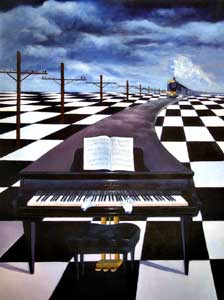
"Road to Nowhere"

This painting called "Road to Nowhere" was done by a Russian surrealist painter named Leonid Shchigel. He's an up an coming artist who takes after Salvador Dali's surreal paintings. Shchigel had no art degree and was completely self-taught as an artist. It wasn't until he began his job as a security guard that he practiced his art daily-utilizing all the free time he had working in the grave yard shift. Rather than focusing on the realistic qualities of life he noticed the unrealistic, but beautiful, qualities dreams so greatly exhibit.


In this painting there is a black piano that turns into train tracks, going into the distance. There is a train in the distance that is coming toward the foreground. It is kind of clear sky's in the distance but closer to the piano there is dark and gloomy sky's. The floor is black and white checkered, like the colors of the keys on the piano. There is a music book on top of the piano opened face up. There is electricity lines down the length on the tracks. There is smoke coming from the train. There is a chair under the piano and the piano looks brand new and not used. No one is to be seen in this painting, the only person maybe would be the train conductor. There are white gloves on the piano "playing" but no visible person.


Our interpretation of this painting is that the train that is in the distance coming towards the foreground is taking a journey to a "darker world". With the clear sky's in the background and the dark, black sky's in the foreground this represents the coming to the "darker world". The dark sky could represent worries and challenges that are going to have to be faced sometime in the near future. Another thing is there are more geometric shapes on the ground and are more defined than all of the other shapes in this painting.